
The photo album problem
A photo album shows what you looked like. It does not say who you were. Here is how to write the part the picture can't.
What the album leaves out
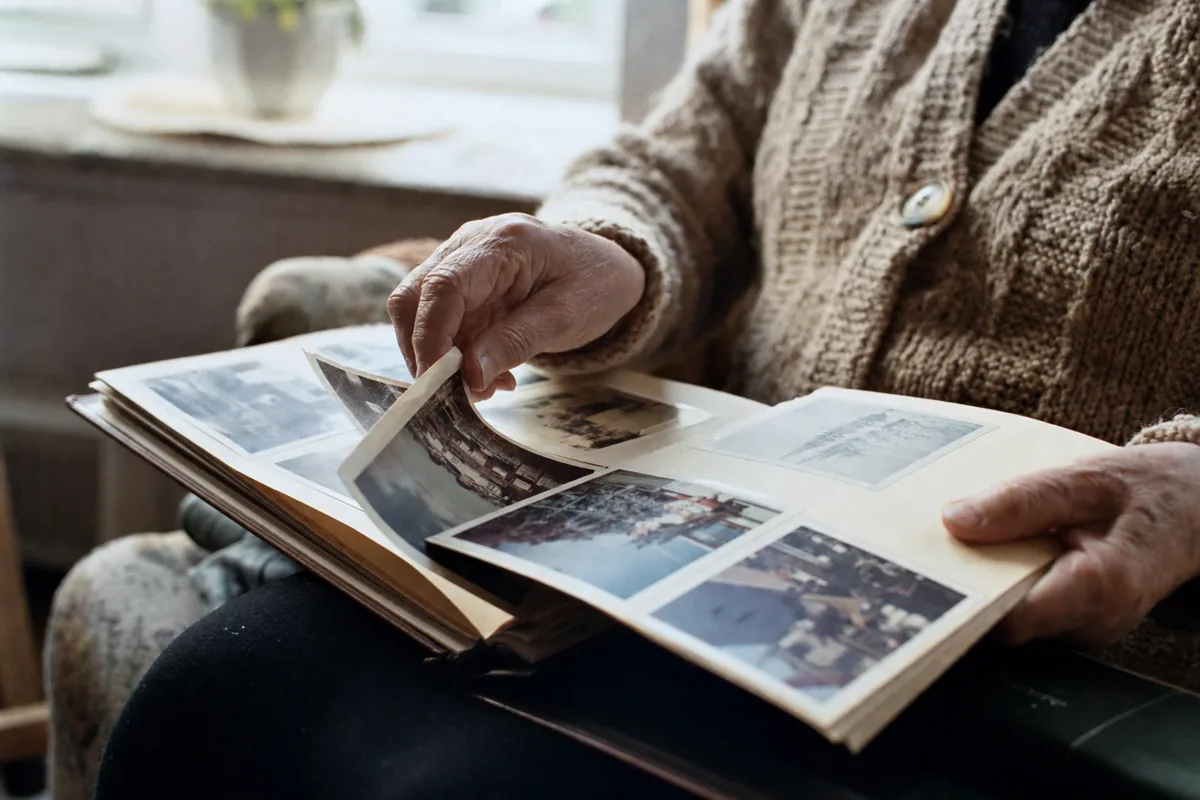
Take any photograph of yourself from thirty years ago. A kitchen, a parking lot, somebody's wedding. You can see the clothes, the haircut, the year, the person standing next to you.
Now ask what the picture actually tells a person who was not there. It tells them you existed on that day and that you owned that coat. What it leaves out is everything that made the day worth remembering: that you had been turned down for the house that morning, that the man beside you was the one who later lent you the down payment, that you drove home and decided to start again in a different town.
A photo album is a record of what you looked like while things were happening. The things themselves are not in it.
What the social page leaves out
A page on a social site has the same hole in it, with a second problem on top.
The first problem is the same one: pictures without the reason. The second is the order. A feed shows a life newest first, in the order a company decided to show it. Nine vacation photographs, a joke, a photograph of a meal, then, somewhere in the middle, without a mark on it, the week everything changed. The feed cannot tell those apart, because it was never built to. It was built to hold attention today.
Your life did not happen newest first. It happened in an order, and the order carried meaning. That is why a page ordered by your life reads like a person and a feed reads like a scroll.
The part the picture can't
The fix is small and it is the whole product. Bring the picture. Then tell the part the picture cannot.
Here is how to write it.
Pick the moment, not the day. Not "our vacation in 1994". The afternoon in 1994 when your brother told you he was moving abroad, and you knew you were going to take the job you had been turning down. One moment. One picture. If two things happened, write two.
Say what changed because of it. This is the sentence people skip, and it is the one that does the work. Something was one way before and another way after. A direction changed. A belief changed. A door closed and you stopped trying it. Write that in plain words: after that I never went back to shift work, or I stopped believing my father had been unfair about it.
Say what you would tell a stranger. Not what you would tell your daughter, who already knows the names, the town, and half the story. Write it for somebody who knows nothing about you. That forces you to say who the people are and why the place mattered, and those are exactly the details a family loses first.
Keep it under a hundred words. Short is not a limitation here. Short is what gets read, and it is what gets finished. A hundred words is five or six sentences, which is about a minute out loud. If you have more, it is usually two moments rather than one.
If writing is the part you dislike
Say it instead. Open the moment, record a voice note, and talk to the person who never knew you as though they were sitting across the table. A minute is plenty. Most people find they are better at this out loud than on paper, because out loud you naturally explain things a stranger would not know.
The voice is also worth keeping for its own sake. A grandchild who has the photograph and the story still has never heard how you say their last name.
A short test
Read the moment back and ask one question: could this have been written by anyone else about anyone else?
If it could, it is a caption. Add the thing only you know. That is the part worth keeping.